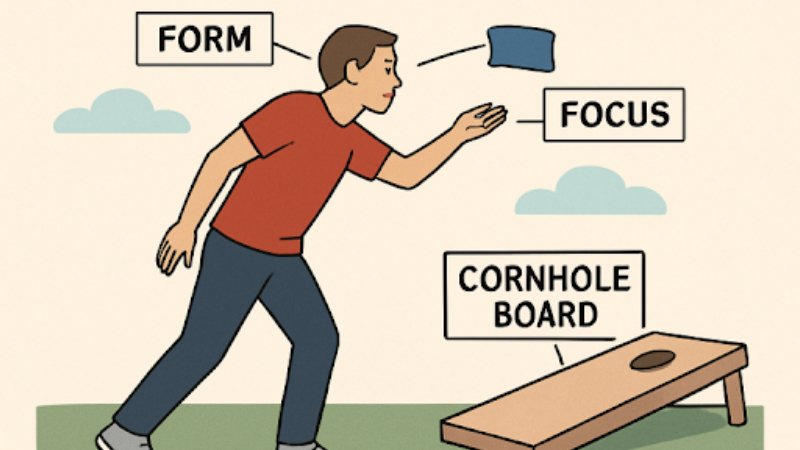
Key Takeaways:
- Developing a consistent throwing technique enhances accuracy.
- Proper grip and release are crucial for control.
- Regular practice and drills can significantly improve performance.
Table of Contents:
- Consistent Throwing Technique
- Proper Grip and Release
- Stance and Body Alignment
- Adding Spin to Your Throw
- Follow-Through
- Practice Drills
- Mental Focus and Strategy
- Equipment Considerations
- Conclusion
Perfecting your toss is often the difference between an enjoyable evening and a competitive showdown in cornhole. Whether you’re new to cornhole or hoping to refine your skills, learning the essentials of cornhole throwing technique will set you apart from casual players and help you land those precise shots that win games.
Improving your accuracy doesn’t require innate talent, but it does demand attention to small details that can be fine-tuned through steady practice and mindful adjustments. By understanding key concepts like grip, stance, release, and mental focus, you’ll be able to unlock consistent play and progress toward mastery with every game.
Accuracy is built upon more than just repetition; it requires the application of fundamental mechanics and strategies that can be easily overlooked. Focusing on your technique and using proper equipment ensures each toss is intentional and controlled. This lets you approach every throw with a clear plan, helping you make those critical shots under game pressure.
For a deeper dive into basic and advanced methods, check out trusted guides from large platforms like ESPN’s cornhole rules and strategies to further expand your understanding of the sport.
Consistent Throwing Technique
Consistency is the foundation of accuracy in cornhole. Creating a repeatable routine each time you step up to throw, establishing the same stance, grip, and throwing motion, leads to muscle memory that translates into improved aim. To build a reliable routine, avoid sudden or dramatic changes in your form. Instead, focus on developing a steady, rhythmic motion that you use every time you release a bag. This kind of repetition is particularly beneficial, as studies on motor learning suggest, for making consistent adjustments and seeing incremental improvement.
Proper Grip and Release
Mastering your grip is crucial. Place your hand flat on the cornhole bag with your fingers spread evenly, allowing a relaxed hold that supports balanced flight. Avoid gripping too tightly since that can alter the trajectory unpredictably. The release should feel smooth and controlled, almost mimicking an underhand bowling motion with your wrist and fingertips imparting a subtle spin to stabilize the bag midair. As you refine your release, pay attention to feedback from your throws and gradually adjust until you find a comfortable, effective rhythm.
Stance and Body Alignment
A stable and well-aligned stance sets the groundwork for an accurate toss. Position your feet shoulder-width apart to maintain balance while facing your target. Your throwing shoulder should be square to the board, while your non-throwing hand helps guide your aim by pointing towards the hole. Keeping your weight centered and your eyes on your target enhances consistency and builds confidence in your aim with each toss.
Adding Spin to Your Throw
Spin stabilizes your bag’s flight, ensuring a flat, predictable approach and reducing the chance of errant flips. To generate spin, allow your wrist to rotate gently as you release the bag, and let your fingers guide the bag’s path as it leaves your hand. Watch how the bag rotates in flight and adjust your wrist motion as needed to produce a smooth, even spin. Spin is especially important in variable outdoor conditions, as a spinning bag is less susceptible to wind or minor surface irregularities on the board.
Follow-Through
Completing your follow-through is essential for maintaining control over your throw’s direction and momentum. After releasing the bag, keep your arm moving in the intended line toward the target rather than stopping abruptly. A correct follow-through subtly stabilizes your entire body, reducing the likelihood of imbalances during delivery and helping solidify the muscle memory necessary for repeated accuracy.
Practice Drills
The most effective cornhole players dedicate time to purposeful practice drills. Exercises such as targeting different regions of the board, imagining pressure situations, or tracking accuracy with specific challenges can sharpen your focus. Set up drills that involve repeatedly aiming for specific holes or adjusting your throwing power from different distances. Deliberate, goal-oriented practice not only corrects flaws but also reinforces your best habits under varying conditions.
Mental Focus and Strategy
Cornhole is as much a mental battle as a test of physical skill. Develop a strategic approach by assessing the score, your opponent’s strengths and weaknesses, and the placement of bags on the board. Decide whether to play aggressively and aim for the hole or to play defensively and block your opponent’s shots. Remaining composed, especially under game pressure, allows you to apply your practiced technique regardless of distractions. Practicing mindfulness and learning to reset after a missed toss can give you an extra edge when the game is on the line.
Equipment Considerations
Even a perfect toss can go awry if your gear is inconsistent. Always use bags of regulation weight and dimensions, and practice on boards that adhere to official sizing and spacing guidelines. Make sure boards are on level surfaces to prevent unpredictable bounces and adjust quickly to varying environmental conditions, such as wind or moisture, that can impact play. Quality, consistent equipment not only supports your skill growth but also ensures that your technique translates accurately in tournament settings.
By carefully focusing on your routine, technique, and mental approach and committing to steady practice, you can see measurable improvement in your cornhole accuracy. With every toss, you’ll inch closer to mastering this classic backyard game and setting yourself up for more competitive, rewarding play.
Conclusion
Improving your cornhole accuracy is a combination of skill, strategy, and consistent practice. By mastering the fundamentals of grip, stance, release, follow-through, and mental focus, you can turn each toss into a controlled, intentional shot. Pairing these techniques with deliberate drills and reliable equipment ensures your performance translates from casual play to competitive scenarios. Remember, progress comes gradually, and every practice session builds the muscle memory and confidence needed to excel. With dedication and attention to detail, you’ll see measurable improvement, making each game more rewarding and bringing you closer to mastering the art of precise bag tossing.